
Pulse
- Jun 15
- 3 min read
Updated: Jul 14
Designing Adaptive Experiences for Intentional State Change
Product Lead | Service Design, UX Systems & Behavioral Experience Design | 2011–2012

Originally developed in 2011, Pulse was a speculative ambient wellness system exploring how adaptive technology, multisensory environments, physiological feedback, and personalized behavioral experiences could support intentional shifts in focus, relaxation, energy, emotional well-being, and sleep throughout daily life.
I led a small interdisciplinary team exploring how connected environmental, digital, and biometric touchpoints could work together to create more responsive and supportive experiences for people navigating various barriers to health, well-being, and performance.
While conceptual in nature, the project explored several emerging technologies and anticipated themes that now shape many modern digital health ecosystems—including adaptive experiences, wearable feedback systems, ambient computing, behavioral personalization, and longitudinal wellness support.
The Core Idea
Our team set out to explore a simple but surprisingly common challenge:
How do we better manage our energy, focus, mood, and overall sense of well-being throughout the day?
As we explored the problem space, we became increasingly interested in the relationship between our environments, sensory inputs, and internal states.
Even subtle changes in lighting, sound, scent, imagery, or messaging can influence how we feel, think, and behave.
Over time, we began identifying key moments throughout the day—what we called inflection points—where small interventions might have an outsized impact on a person's mindset, motivation, or emotional state.
One example was the transition from sleep to wakefulness. How might someone's outlook, energy, or motivation change if they woke up to uplifting imagery, energizing scents, personalized content, or environmental cues designed to support the kind of day they wanted to have?

Our new focus question became:
What if technology could help orchestrate these environmental and sensory cues more intentionally?
Rather than simply delivering information, could it help create conditions that support positive shifts in focus, relaxation, energy, mood, and overall well-being?
The Pulse Ecosystem

After exploring emerging technologies and early wearable trends, we developed an integrated ecosystem of physical and digital experiences designed to support different states, routines, and moments throughout the day.
At the center of the system was a portable device that acted as an environmental experience hub, incorporating visual projection, audio, lighting, scent diffusion, voice interaction, and mobile connectivity to create immersive multisensory experiences tailored to different goals and routines.
Users could create and manage personalized experiences through connected devices, selecting combinations of visual environments, guided content, soundscapes, environmental lighting, scent profiles, scheduling tools, and more.
The ecosystem also included wearable sensors designed to track physiological and behavioral data such as movement, body temperature, sleep patterns, and energy levels. This information informed personalized experiences including intelligent wake timing, environmental adjustments, energy management support, and behavioral guidance.
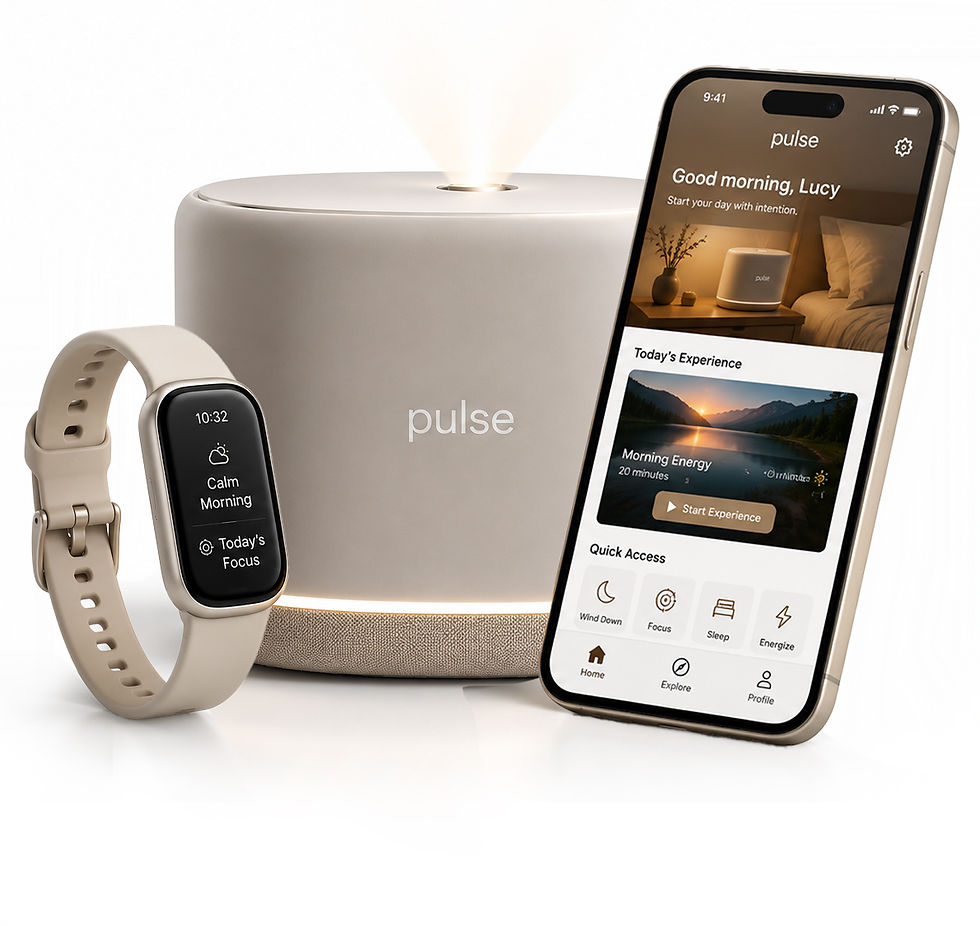
Rather than relying on a single intervention, Pulse brings together environmental, behavioral, and digital touchpoints that work together to help people intentionally shape the conditions that influence how they feel, think, and function.

Systems Design & Experience Mapping
The project focused heavily on systems thinking and longitudinal experience design rather than isolated interface design. We mapped:
User emotional states
Contextual needs
Environmental touchpoints
Behavioral triggers
Progression flows
Sensory interactions
Feedback loops
Cross-platform interactions
The system brought together multiple layers of data, experience, and behavioral support, including:
Biometric and behavioral inputs
Environmental and sensory controls
Personalized content and guidance
Focus, energy, and relaxation experiences
Voice, mobile, and wearable interactions
Scheduling and motivational systems
Feedback and progression mechanisms

Content & Experience Libraries
One of the most exciting aspects of the Pulse concept was the opportunity to move beyond standalone content and toward a library of personalized, multi-sensory experiences.
The system could draw from visual, auditory, and olfactory components combining them into curated experiences designed to support specific goals.
Beyond content hosted by Pulse, the platform also created opportunities for wellness experts, coaches, educators, creators, and even users themselves to develop and share experiences, opening the door to a growing ecosystem of community and professionally developed content.
Reflection
Looking back, what still stands out to me about this project isn’t necessarily the specific technology concepts, but the systems-oriented thinking behind it.
Many of the adaptive capabilities we envisioned were still constrained by the technology available at the time. Most experiences were designed to be user-configured rather than dynamically personalized. Even so, the underlying idea was the same: creating systems that could help people intentionally shape their environments and experiences in ways that support better focus, energy, mood, and well-being.
Today, advances in AI, ambient computing, biometric sensing, and behavioral modeling make many of those ideas significantly more achievable than they were when we first explored them.